Micro-Drama, Macro Disruption
How China’s 90-Second Soap Operas Became a $14B Industry—and the Next Big Entertainment Export


1. Opening Scene: The Rise of the 2-Minute Cliffhanger
“This $0.30 Chinese soap beat Netflix in the U.S. App Store.”
That’s not a headline from 2027—it’s what happened in 2024. A micro-drama app called ReelShort, backed by Chinese tech company COL Group, climbed to the top of U.S. entertainment app charts, briefly outpacing Netflix and Hulu. And it wasn’t even close. The app didn’t need hour-long prestige TV shows or cinematic visuals. Just fast-moving, vertical stories told in 90-second bursts—filmed in weeks, monetized in minutes, and consumed in bed, on the bus, or during a coffee break.
Welcome to the 短剧 (duǎnjù) revolution—China’s mobile-first, low-cost, high-engagement answer to the attention economy.
This is not a TikTok clone. Nor is it YouTube Shorts. It’s something else entirely: a new storytelling format, industrialized and serialized, designed from the ground up for micro-monetization, binge loops, and ultra-targeted content. Think of it as the TaoBao of drama—cheap, addictive, and relentlessly optimized.
And here’s what’s wild: this content model is now worth billions. In 2023 alone, China's micro-drama market hit ¥373.9 billion (~$5.3B USD), surging 267% year-on-year, with projections that it will surpass ¥1 trillion (~$14B USD) by 2027.
The content is simple: a poor girl falls for a CEO; a reincarnated princess seeks revenge; a supernatural twist lurks behind a familiar setup. Critics call it formulaic. Users call it irresistible.
But here's the real twist: this isn't just a Chinese phenomenon anymore. This is China's biggest soft content export since TikTok. While the West obsesses over AI video generation and streaming wars, China has quietly reinvented TV for the thumb-scroll era.
And if you're still asking whether it's "real storytelling"... you’re asking the wrong question. The question is: why is it working? And why now?
This piece dives deep into the numbers, platforms, and mechanics of China’s short-drama boom—and lays out why this under-the-radar format might be the next frontier for creators, investors, and platforms in the West.
2. Act I: China’s Micro-Drama Machine
2.1. Origins and Definitions: What Exactly Is a 短剧?
The word 短剧 (duǎnjù) translates literally to “short drama,” but don’t mistake it for just a mini soap opera. These are mobile-native serial narratives, often 1–3 minutes per episode, designed specifically for vertical viewing on smartphones. A full series can run 20 to 100 episodes, which together add up to a bingeable experience—often less than the runtime of a single Netflix episode.
The early form of 短剧 was born out of Douyin (TikTok’s China version), Kuaishou, and Bilibili, where amateur creators began posting serialized relationship drama in short form.
The genre professionalized quickly around 2020–2021, with studios like Xiguang Culture and platforms like ReelShort or Yuewen beginning to industrialize the format.
In essence, 短剧 is the soap opera for the swipe era—condensed, emotional, relentlessly optimized for attention.
Typical tropes: "霸总爱上我" (The Domineering CEO Falls for Me), reincarnation revenge arcs, tragic love triangles, supernatural abilities, arranged marriages, and endless cliffhangers.
Tagline-worthy formula: Low budget. High tension. Fast payoff.
2.2. By the Numbers: A $14B Market in the Making
If you think short video storytelling is a side show, think again. According to data from iiMedia Research and Miaozhen Systems, China's micro-drama market has exploded from obscurity to industrial scale in just five years:
2023 market size: ¥358.6 billion (≈$5.02B USD)
YoY growth: 234.5%
2028 forecast: ¥1.01 trillion (≈$14.19B USD)
And this isn’t hype—it’s monetized, regulated, and increasingly global.
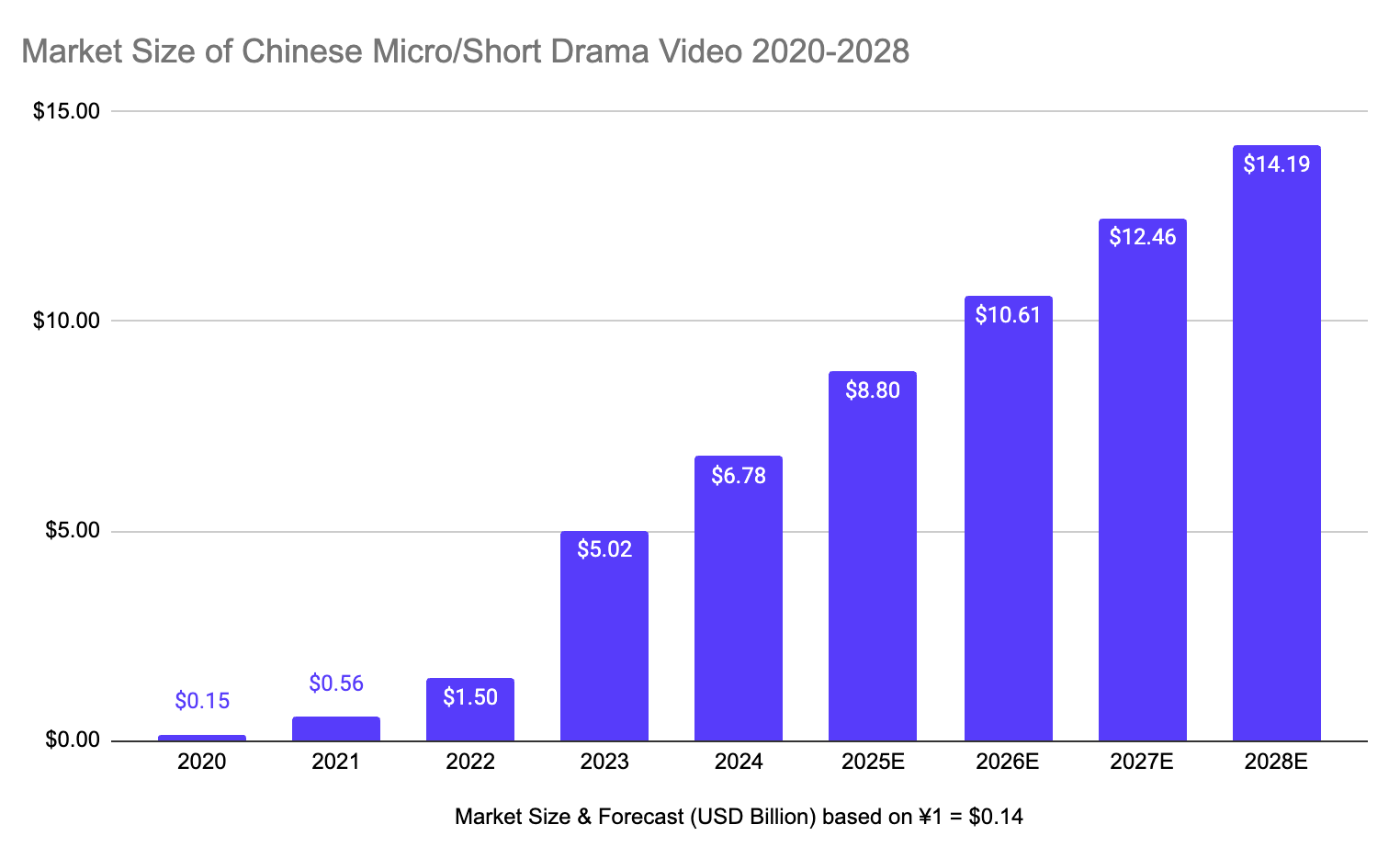
The growth is driven by a perfect trifecta:
Ultra-low production costs: Dramas are produced in under three weeks, with budgets as low as ¥200K.
Frictionless viral distribution: Leveraging Douyin, Kuaishou, and WeChat for instant, algorithm-driven reach.
Hyper-efficient monetization: Freemium models, micro-payments (~¥1–2/episode), and bundled unlocks drive high ARPU.
These dramas don’t need TV stations or theatrical releases. They’re born digital—launched through apps, monetized instantly, and virally scaled through social media swipes.
In short: the attention economy has found its most profitable format yet, and it fits in the palm of your hand.
2.3. The Economics of Speed and Scale
One of the biggest reasons 短剧 works in China is how cheaply and quickly they can be made.
MetricValue RangeTypical Budget¥200,000 – ¥2 million (~$28K–$280K USD)Production Time5–20 daysEpisode Length1–3 minutesTotal Episodes per Show20–100Monetization Model¥1–2 per episode, or ¥39.9–49.9 full series
Platforms like ReelShort, Tomato Novel (番茄小说), and Midu have optimized script writing using AI, casting from gig actor pools, and batch shooting locations to further compress costs.
Compare that to Netflix’s $2M+ per episode spend, and you begin to see the scale arbitrage.
2.4. Who’s Watching? The Surprising Demographic Story
Contrary to Western assumptions, this isn’t just Gen Z clickbait.
According to surveys:
37.3% of micro-drama viewers are aged 40–59
12.1% are over 60
>60% of users rewatch episodes
>70% of viewers are female
Why?
Older users are used to serialized TV and are comfortable with app-based content.
Women are the dominant consumer base for romantic and emotionally charged narratives.
Micro-dramas meet the emotional tone of soap operas but in a faster, more mobile-friendly form.
2.5. Platform Ecosystem: Not Just Douyin
Let’s map out the ecosystem:
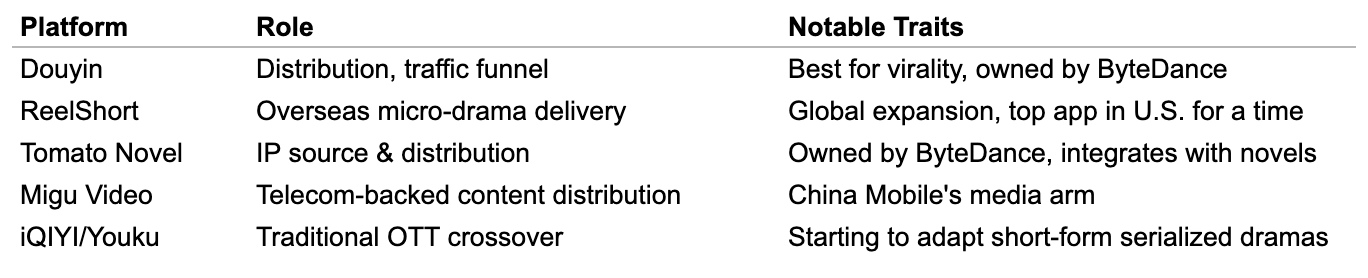
ByteDance is using the same flywheel from its TikTok playbook:
Novel ➝ Short Drama ➝ Monetization ➝ AI Loop ➝ Data-Driven Hits
2.6. Regulatory Crackdown: Censorship Meets Scalability
With speed came recklessness—and in 2024, that caught the attention of regulators.
Over 25,300 micro-dramas were removed for content violations in 2023–24.
Offenses included: vulgar content, glorified infidelity, supernatural themes, and “moral distortion.”
In 2025, China passed new licensing requirements: all short dramas must now obtain online distribution approval, just like full-length films or series.
As one exec from a top drama studio said:
“We’re not just racing against algorithms now—we’re racing against the censors.”
Yet, even with regulations, the industry is thriving. Studios have adapted by:
Producing “cleaner” romance content
Emphasizing traditional values and happy endings
Distributing overseas where rules are looser (more on that in Act III)
2.7. The Coming AI Inflection Point: Industrialized Drama Is Still Manual
Here’s what most people don’t realize:
Everything you’ve read so far—billions in revenue, explosive growth, global expansion—has happened before the widespread use of generative AI in content production.
Today’s micro-drama ecosystem in China is still largely:
Scripted by humans (often adapted from web novels)
Cast with entry-level actors
Shot in bulk on physical sets
Edited and localized manually
Marketed with human-generated thumbnails and trailers
Yes, some platforms use AI for script support, and sure, there's A/B testing for thumbnails and titles. But we haven’t yet hit the full-stack automation phase. And when we do, the game will change—fast.
Imagine this near future:
A producer feeds a 5-line prompt into an AI writing engine. It generates a 50-episode romance arc in seconds, complete with dialogue.
AI avatars voice the characters in Mandarin, English, Thai, and Spanish—automatically localized.
Virtual actors are composited into stock set backgrounds.
Auto-thumbnailers and title generators spin up 100 variations, all A/B tested in real-time on Douyin.
The entire process costs 1/10th of a traditional shoot—and can be replicated infinitely.
This is not science fiction. It's already happening in fragments.
Platforms like:
ByteDance are testing AI script generation through Tomato Novel’s backend.
Kuaishou is experimenting with AI-generated voiceovers and low-cost deepfake actor insertions.
Startups like DramaGPT, MOVIO, and HeyGen are building full-stack solutions for AI actors, voices, and lipsync.
💸What This Means for Economics:
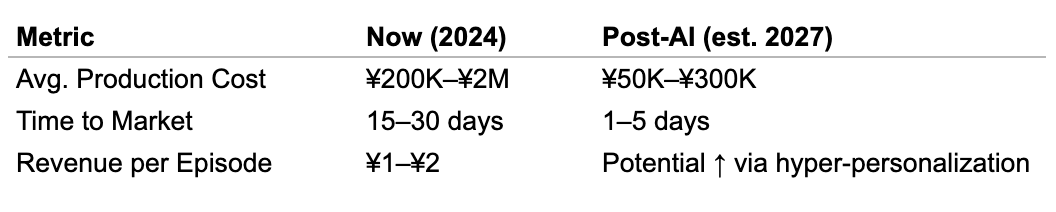
Production cost could drop another 60–80%
Time-to-market shrinks to days, even hours
A/B testing isn't just for marketing—it's for the drama itself
Personalized narrative paths become feasible (“Did you like the CEO ending? Here’s the villain POV cut.”)
⚠️ And It Will Be Global
Unlike traditional Chinese entertainment exports, AI-generated drama doesn’t suffer from language, cultural, or casting barriers. It can be:
Subtitled and voiced in any language instantly
Genre-adapted to local tastes (e.g. urban romance for LatAm, vampire thrillers for U.S.)
Delivered through existing platforms like TikTok, YouTube Shorts, or even Discord
We’re still in the ‘manual factory’ stage of a format that is built to be automated.
The moment full AI integration hits, short drama won’t just be fast, cheap, and addictive—it’ll be infinite.
And the studios, platforms, and investors who understand this before the transition will have a compounding advantage no different from those who bet early on mobile-first content in the 2010s.
🧰 Sidebar: The AI Toolchain for Micro-Drama (Early Signals)

🎬 Prototype Today:
A studio can now generate a 10-episode series using tools like ChatGPT for script + HeyGen for voice + Runway for cuts—for <¥10,000.🚀 What’s Missing?
Real-time viewer interaction (branching narratives)
Emotionally coherent long arcs from LLMs
Legal frameworks for AI actor rights
Estimated Impact of Full-Stack AI on Short Drama
🧱 Sidebar: Narrative Infrastructure — The New Stack
From Single Scripts to Generative Pipelines
We’re shifting from storytelling as a craft to storytelling as infrastructure—modular, agentic, and infinitely replicable.
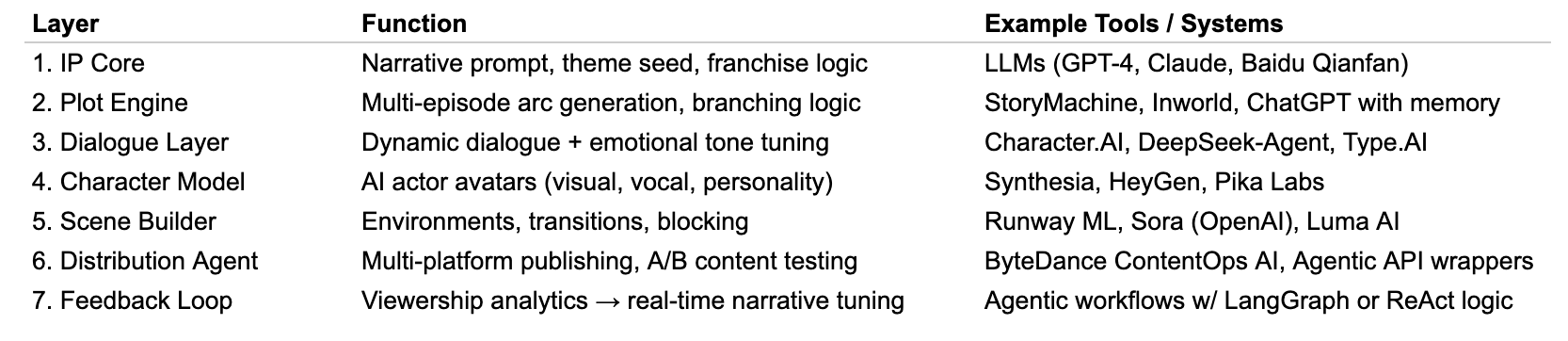
This is “LLM meets Hollywood meets DevOps.”
Scripts aren’t written—they’re compiled.
Episodes aren’t shot—they’re rendered.
Stories aren’t published—they’re deployed, versioned, and optimized.
Think of it as the AWS of storytelling—where characters are APIs, dialogue is synthetic, and plot arcs are scaffolded, version-controlled, and regenerated by feedback.
3. Act II: Why It Works in China
The micro-drama boom isn’t just a case of viral content—it’s the result of system-level alignment. China didn’t set out to reinvent storytelling. It just happened to have the right user base, infrastructure, and monetization mechanics at the right time.
This is product-market fit at ecosystem scale.
3.1. Mobile Infrastructure + Super App Logic
China's consumer internet never went through a PC phase. Over 99% of users are mobile-first, and most of their time is spent inside super apps like Douyin, WeChat, and Kuaishou. These platforms integrate:
Algorithmic content feeds
Wallets (WeChat Pay, Alipay)
Social sharing
Video recommendation and A/B testing
As a result, short dramas aren’t distributed—they’re injected. A user swiping for cat videos might instantly get hooked by a 2-minute scene from a romance drama and end up spending ¥39.9 to unlock the rest. The entire funnel—from discovery to payment—is native, optimized, and invisible.
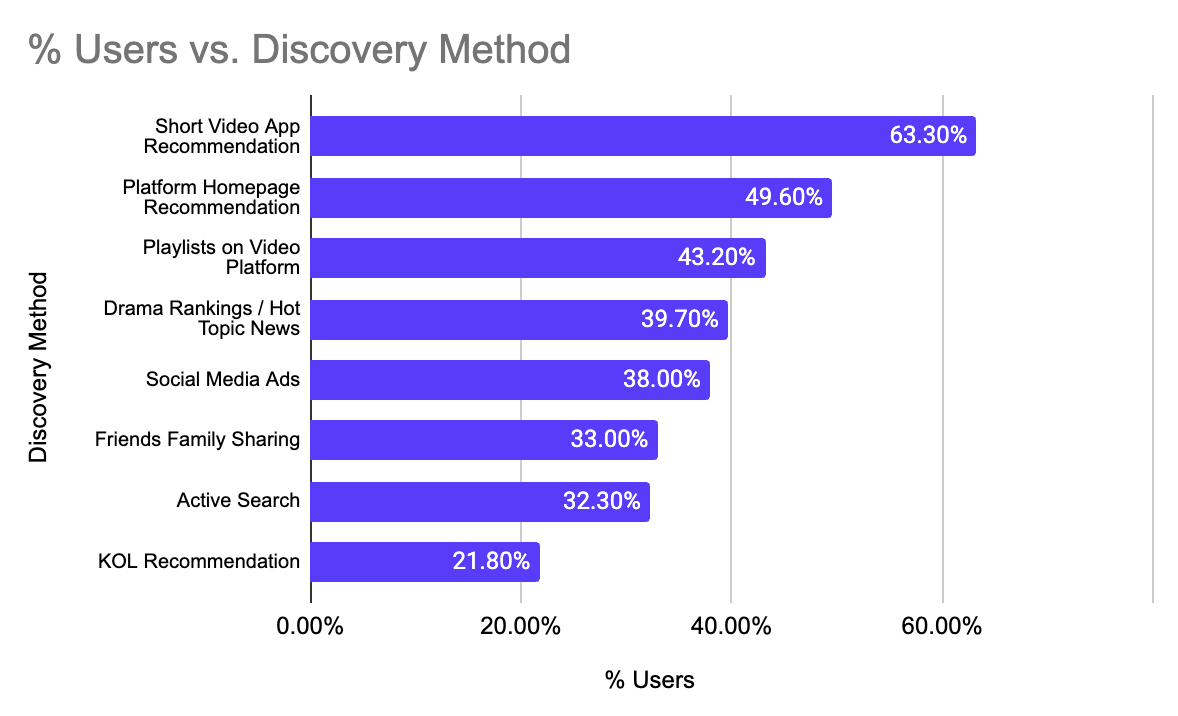
3.2. Behavioral Fit: Built for Scroll-Time, Not Prime Time
This isn’t binge culture. It’s bite-sized immersion. The average episode is under 3 minutes. A full series might have 80–100 episodes, but each one is engineered for a single beat—jealousy, betrayal, a kiss, a slap.
Key user motivations:
65.2%: Kill time
63.1%: Decompress
41.6%: Explore different lives or perspectives
35.8%: Visual stimulation or emotional intensity
These aren’t prestige narratives. They’re emotional pulses tuned to the rhythm of the feed. Every few seconds delivers payoff, cliffhanger, or click-through. That’s why users come back—not for resolution, but for the loop.
3.3. Payment Designed Like a Game Economy
Micro-drama monetization mirrors mobile gaming: freemium front-load, micro-unlocks, and low-friction decision-making.
51% of users prefer paying for a monthly/yearly platform pass (unlimited viewing)
27% opt for one-time unlock of a full series
22% buy episode-by-episode as they go
Most users spend ¥11–¥50/month (~$1.50–$7 USD). This price point doesn’t trigger subscription fatigue—it fits into mobile wallet logic.
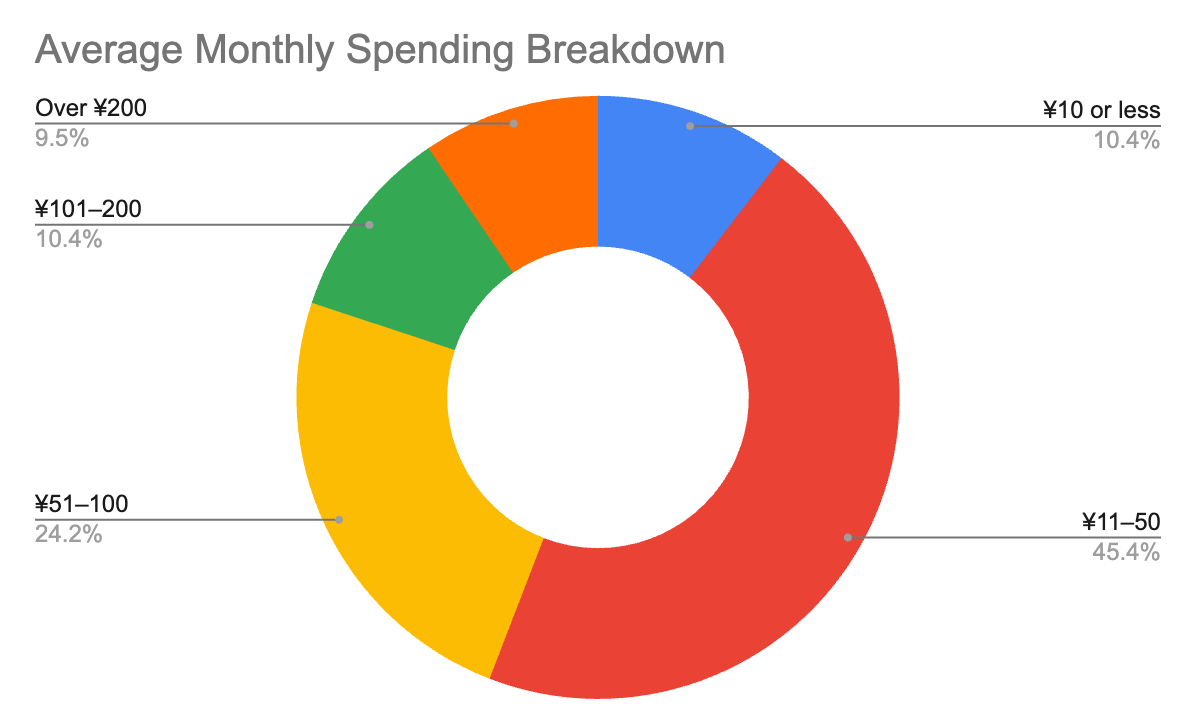
These amounts are impulse-aligned, not commitment-aligned. Users don’t feel like they’re subscribing. They’re tipping the algorithm.
3.4. Platform Incentives Align Perfectly
For platforms, micro-dramas do three things exceptionally well:
Extend session time
Increase in-app purchases
Improve retention across demographics
That’s why Douyin integrated its short drama push directly with its Tomato Novel IP factory, and why Kuaishou saw a 300% YoY increase in paying users in Q4 2023 after embedding episodic content into its native feed.
Short dramas aren’t just content—they’re retention infrastructure. The algorithm doesn't just show users what they like; it learns which stories to fund next.
3.5. Cost-Efficient Supply, AI-Ready Workflow
The economics of production are almost frictionless:
MetricValueBudget per series¥200K–¥2M ($28K–$280K)Turnaround time2–4 weeksEpisode length60–180 secondsTotal episodes50–100 per series
Because production cost is low and failure is cheap, studios can run dozens of parallel experiments. Many use AI already for:
Drafting dialogue
Title optimization
Voiceover localization
Thumbnail generation
We're still in the semi-manual phase, but the stack is primed for automation. The creative pipeline is modular—and that makes it scalable.
3.6. The Audience Is Broader Than You Think
This isn’t Gen Z fare.
36.7% of users are aged 20–39
37.3% of users are aged 40–59
55% are female
57.1% have university degrees
The largest segment lives in new first-tier and second-tier cities
That last point is critical: these are rising consumers. They’re mobile-native, brand-aware, and conditioned to pay for content—as long as it feels casual.
3.7. Original Content Outperforms Licensed IP
Contrary to assumption, users prefer original dramas over adaptations from known IP (53.3% vs. 32.7%). Why?
They feel more relevant and less formulaic
The pacing is optimized for short video—not retrofitted
Viewers associate originals with novelty and freshness
Production teams can iterate faster without licensing bottlenecks
This is important because it shows a shift in what audiences value: not prestige, but format fluency.
3.8. Everything Is Measurable—and That Changes the Game
Every component of a short drama—from script pacing to episode title—is testable. Not after release, but as it airs. This changes the role of storytelling from fixed artifact to performance object.
Viewership becomes real-time feedback.
Thumbnails, actors, and story arcs are optimized like ecommerce funnels.
Poor-performing scenes get buried. High-performing twists get spun into sequels.
The story isn’t the product. The format is the product.
And in China, that product is already industrialized.
4. Act III: The Export Playbook
The short drama model was built for China. But it won’t stay there.
By 2024, Chinese platforms began deploying the format globally—starting with English-language content in the U.S., Southeast Asia, and Latin America. The early traction is real. But so are the friction points.
This isn’t a cultural export. It’s a systems export. And most countries don’t have the systems yet.
4.1. What’s Already Working Outside China

Chinese-backed apps like ReelShort, DramaBox, and FlexTV have entered U.S. and Southeast Asian markets with promising results:
ReelShort hit #1 in U.S. entertainment app charts (2024), surpassing Netflix.
Series with 100+ episodes, priced at ~$0.30 per unlock, are showing strong retention.
Themes adjusted for Western taste: werewolves, supernatural romance, office drama.
Core Format:
Vertical video
1–3 minute episodes
Pay-to-unlock structure
Translated and AI-voiced
Distributed through standalone apps, not TikTok/YouTube
🧠 Observation: The mechanics hold. What changes is the skin—genre, language, cultural pacing.
4.2. Structural Breaks in the Global Stack
What works in China fails elsewhere because the supporting ecosystem doesn’t exist:
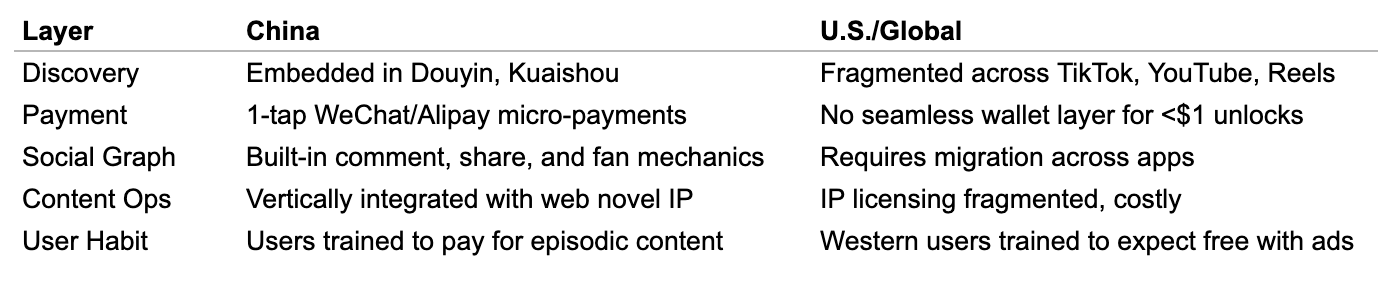
🧠 Conclusion: The format cannot simply be “localized.” The entire monetization + distribution stack has to be rebuilt.
4.3. What Must Be Rebuilt (or Invented)
To scale micro-dramas globally, three core layers must be solved:
1. Discovery + Retargeting
Existing short-form platforms (TikTok, Reels) don’t support deep narrative threading.
No retargeting across episodes or tracking binge behavior.
✅ Opportunity: Build standalone feeds or in-app micro-drama tabs with stateful viewers and skip-resume memory.
2. Monetization Infrastructure
Pay-per-episode works in China due to wallet ubiquity.
In the U.S./EU, app store fees and low ARPU make this unworkable at small scale.
✅ Opportunity: Hybridize with rewarded ads, tokens, or memberships. Adopt gaming-style economies.
3. Creator Supply Chain
China has a trained bench of short-form screenwriters, editors, voiceover freelancers, and A/B testing operations.
The West doesn’t.
✅ Opportunity: Use AI to fill this gap—script, storyboard, translate, dub, and distribute at near-zero marginal cost.
4.4. Who’s Positioned to Win
Option 1: TikTok builds it in-house
Pros: User base, feed control, behavioral data.
Cons: No payment infra, regulatory risk, creator ops are entertainment-first, not narrative-native.
Option 2: Webtoon/Wattpad evolution
Pros: IP depth, serialized literacy, some monetization built-in.
Cons: Weak video capability, slow on mobile-first UX.
Option 3: A new player with full-stack control
Vertical video app
Hybrid monetization (ads + unlocks + tokens)
AI-native production
Creator and fan ecosystem baked in
🧠 Real Take: This is a land grab for whoever can own the first global mobile-native story engine. Not streaming. Not books. Not TikTok. Something new.
4.5. The Strategic Blueprint
What a global short drama stack needs:
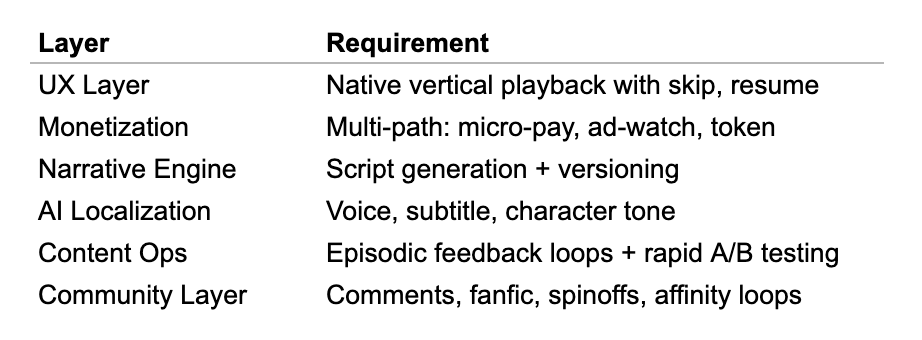
Until someone builds this full loop, the global short drama format will remain an import experiment—not an exported ecosystem.
5. Act IV: Where AI Changes the Economics
The short drama model is already profitable in China—before full-scale AI adoption.
But AI doesn’t just make it cheaper. It makes it programmable.
Once AI moves from assistive tool to production engine, the short drama format moves from episodic storytelling to narrative infrastructure: scalable, localized, and eventually personalized at runtime.
5.1. AI Reduces Cost, Time, and Human Bottlenecks
Before: 2–4 weeks to produce a 100-episode short drama, ~$30K–$280K per series
After: 48–72 hours to generate multi-version series, ~$1K–$10K total stack cost
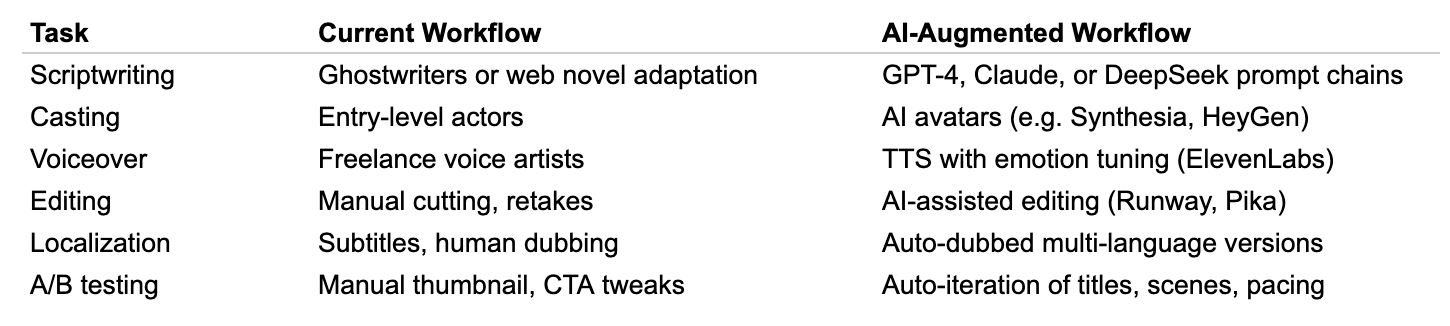
🧠 Impact: Every dollar of cost and every hour of delay can be compressed by >80%.
This turns content production into something closer to ecommerce SKU creation—with a plot generator instead of a supplier.
5.2. Narrative Can Become Modular and Recombinable
LLMs allow story arcs to be broken into components:
Character tropes (CEO, rival, best friend)
Conflict archetypes (betrayal, forbidden love, revenge)
Emotional pacing curves (slow burn, instant attraction, multiple fake endings)
These components can be recombined to:
Personalize for different audience segments
Localize tone and taboo boundaries (e.g. U.S. vs Indonesia vs UAE)
Generate alternative arcs and spinoffs on-demand
🎥 Example: Watch this AI-generated performance by @jacopo_reale. It’s short, strange, and fully synthetic—yet emotionally magnetic.
This isn’t full drama production yet—but it hints at what happens when AI controls rhythm, tone, and visual cadence.
Think: Netflix "Choose Your Own Adventure" at scale—but without human writers or filmed options.
5.3. Multi-Versioning Is No Longer a Luxury
Once AI generates dialogue, voices, and even character animation:
A single drama can have 5 culturally localized versions
Each version can emphasize different emotional beats or endings
Viewers can select tone (light/serious), gender dynamics, or even regional dialects
🧠 Strategic Shift: You don’t build one series. You build a matrix of variations and let the algorithm match user to narrative.
5.4. AI Transforms Unit Economics
📉 Before AI:
$0.15–$0.30 cost per episode
LTV per user: $2–$10 across 1–2 series
Break-even requires 50K+ paying users📈 After AI:
$0.01–$0.05 cost per episode equivalent
LTV scales via personalization + bundled content
Break-even possible with 5–10K paying users
AI removes production as the bottleneck. The bottleneck becomes distribution, conversion, and retention—a pure performance marketing game.
5.5. Creator Economics Will Split in Two
As AI scales:
“Narrative ops” teams will replace traditional production crews.
Indie creators will run short drama shops like Shopify storefronts—with tools like Midjourney, GPT-4o, Sora, and ElevenLabs.
High-performing creators may train custom GPTs to maintain tone, pacing, and world consistency.
🧠 Parallel: The rise of micro-drama with AI looks less like Netflix—and more like Etsy meets gaming.
5.6. Platform Opportunity: Story-as-a-Service
For platforms, AI unlocks full-stack monetization:
Charge per unlock
Offer user-specific narrative “skins” or arcs
License the generation engine to brands, creators, or fan communities
Treat stories as programmable primitives—generated, versioned, and personalized at scale
This is not a media category. It’s a new interface for narrative interaction—and whoever builds the full stack owns the infrastructure of serialized emotion in the mobile era.
The model is already evolving—from episodic content to real-time, reactive story systems.
What TikTok did for video, this new stack will do for drama:
Compress it
Localize it
Personalize it
Distribute it infinitely
And the competitive advantage won’t come from producing the most content.
It’ll come from controlling the engine that can generate anything.
🎬 Sidebar: Top AI Video Generation Tools (2025)

🧠 Key Takeaway:
No single tool can yet do full-scene emotional storytelling with continuity. But used together—like a composable stack—they can automate 60–80% of production for certain genres.
6. Act V: What’s Still Missing
The micro-drama format is proven.
AI is collapsing production costs.
Global distribution is accelerating.
But infrastructure alone won’t win. For this format to scale sustainably beyond China, across platforms and cultures, several core challenges remain—none of them creative, all of them structural.
6.1. Discovery Is Still Dumb
The core UX of short drama discovery is broken outside China.
TikTok, Reels, and Shorts are designed for disposable media, not multi-episode arcs.
There’s no memory of what episode you stopped on.
No re-targeting or skip-resume UX.
No trigger for anticipation or narrative continuity.
🧠 Why it matters: Without persistent story state and intent signals, serialized content can’t compound engagement.
✅ What’s needed: Stateful short-form video feeds with story tracking, binge logic, and skip logic—Netflix meets TikTok, but for 3-minute arcs.
6.2. No Wallet Layer
The Chinese model runs on frictionless micro-payments.
The global ecosystem does not.
App Store tax kills <$1 unlock pricing.
No seamless wallet layer for pay-per-episode mechanics.
Western users are conditioned to expect either free with ads or flat-rate subscriptions.
🧠 Why it matters: Monetization friction breaks the LTV model.
✅ What’s needed: A hybrid layer—ad unlocks, token bundles, one-tap fast purchases—ideally integrated at platform level or through an SDK-like stack (think Paddle, not Patreon).
6.3. Quality Control at Scale
Generative AI allows content proliferation. But most AI-generated storytelling today is:
Flat in emotional progression
Poor at character consistency
Repetitive in plot mechanics
Lacking human nuance or timing
🧠 Why it matters: Volume doesn’t equal retention. One bad arc kills trust in the format.
✅ What’s needed: Narrative testing frameworks, emotion pacing models, character memory across arcs—and editorial AI agents to flag coherence breakdowns before release.
6.4. Trust, Moderation, and Brand Safety
Short dramas thrive on emotionally intense, often taboo themes. But:
Regulatory bodies don’t distinguish between platform-pushed narrative content and user-generated video.
AI-generated scenes blur lines around consent, realism, and misinformation.
Localization may accidentally trigger cultural backlash or political risk.
🧠 Why it matters: One scandal—deepfake celebrity love triangle, racist translation error, political allegory gone viral—could freeze an entire market.
✅ What’s needed:
AI content review pipelines
Ratings standards for short drama formats
Viewer control over themes, boundaries, filters
6.5. IP Law Is Out of Sync
AI-generated content blurs authorship. Micro-dramas remix genre templates, web novels, memes, and fan tropes—often without attribution.
Who owns an AI-generated story built off public domain tropes?
If users remix or re-version episodes, what governs that usage?
Platforms risk lawsuits for “style replication” and derivative work violations.
🧠 Why it matters: The short drama format is inherently recombinant. But legal frameworks still treat content as fixed authorship assets.
✅ What’s needed:
Licensing models for templates, characters, and narrative formats
Platform-level contracts for AI-assisted creators
Copyright law evolution that accommodates procedural narrative generation
6.6. Creator Incentive Structures Are Missing
In China, studios already operate with monetization contracts, revenue share formulas, and IP acquisition deals.
Globally, that layer is missing:
There’s no standard format for serialized short-form content
No embedded monetization tools for indie drama creators
No creator-facing data loop to support iteration or success tracking
What’s needed is not just tooling—but a marketplace logic:
Versioned stories
Remixable characters and arcs
Smart contracts for collaborative IP
AI feedback to drive retention-focused storytelling
Until that infrastructure is in place, global short drama will remain a patchwork of isolated experiments.
The problem isn’t talent or tools.
It’s that no one has built the system to operationalize the format at scale.
7. Act VI: The Strategic Frontier
The short drama boom looks like a content revolution.
It’s not. It’s an infrastructure shift.
The real game isn’t in telling better stories—it’s in building a system that can generate, test, monetize, and adapt stories like software.
Whoever builds that system first—at global scale—doesn’t just win short drama.
They own the next-generation storytelling engine.
7.1. This Is Not a Content Business
Content scales linearly.
Infrastructure compounds.
Short dramas don’t behave like Netflix episodes. They behave like:
Product SKUs (A/B tested)
Mobile games (monetized through behavioral loops)
Creator templates (remixed by communities)
Ads (tuned for retention and click-through)
🧠 Implication: The unit of value is not the episode. It’s the engine that can generate and optimize 1,000 of them—with feedback loops baked in.
7.2. The Real Moat: Feedback Loops
The strongest players in this space won’t just have:
Content libraries
Generative pipelines
Distribution channels
They’ll have feedback loops that get smarter with every view.
Netflix has data.
TikTok has feedback.
The next great platform will have narrative-level optimization:
Pacing curves
Character variants
Emotional resolution tracking
Viewer-specific arc tuning
That’s not a studio. It’s a narrative engine with reinforcement learning.
7.3. The End State Is Programmable Storytelling
We are heading toward an interface where:
Stories are prompted, not pitched
Creators orchestrate systems, not scripts
Viewers shape arcs in real time
Monetization adapts dynamically to genre, user type, and geography
This isn’t speculative. Every piece already exists:
LLMs for dialogue
TTS for localization
AI actors and virtual avatars
Auto-editing tools
Attention feedback from swipe data
Wallet integrations
What’s missing is the orchestrator—the stack that turns all these fragments into a flywheel.
7.4. The Strategic Position to Own
If you control the story loop, you control:
Viewer attention
Creator behavior
IP surface area
Monetization mechanics
Cultural influence
Whether it’s ByteDance, a Webtoon upstart, or a new AI-native platform—whoever builds this flywheel owns the protocol for real-time narrative.
It’s not “TV, but shorter.”
It’s a shift from publishing to deployment.
From finished content to ongoing systems.
Final Frame
Short dramas are the proof of concept.
The engine is the product.
This isn’t the future of content.
It’s the future of control.
💬 Let’s Keep the Conversation Going
If this sparked ideas—or challenged how you think about media, platforms, or storytelling—I’d love to hear it.
📤 Share this with a founder, investor, or operator building in AI, content, or creator infrastructure.
💬 Comment below: What do you think is the most underrated layer in the narrative engine stack?
📩 Subscribe for more deep dives into the future of AI-powered creativity, attention economics, and digital infrastructure.
Thanks for reading. Let’s not just talk about the future of media—
Let’s build the system that runs it.