Preparing the Next Generation for an AI-Powered Future
The Shift from Math Thinking to Systems Thinking:

A Simple Homework Moment That Says It All
A friend of mine recently shared a story about her 9-year-old son’s math homework. The task was simple—calculating the area of a rectangle. In the past, kids would rely on teachers or textbooks to guide them. But in today’s AI-driven world, his first stop was Doubao, a popular AI-powered homework assistant in China. It quickly gave him the correct answer, but when my friend asked him to explain the steps behind the solution, he froze. He had the right answer but no clue how to get there.
That moment hit me hard. Getting the right answer isn’t enough anymore. If AI can solve these problems, what should we actually be teaching our kids? It’s no longer about memorizing formulas or solving problems—it’s about understanding the process behind those problems and designing the systems to solve them. This is the future of education in the AI era.
1. The Traditional Education Model: A Focus on Execution
For decades, the education system has revolved around technical mastery—solving problems, memorizing formulas, and executing predefined steps. This worked because, in the past, technical skills like math and coding were rare and highly valued. The more you could solve problems, the more value you added.
Math class was all about formulas and fixed methods. Coding meant memorizing syntax in languages like Python or C++. Problem-solving was a straight line from question to answer.
But now, AI has changed the game. It can write code, solve math problems, and perform complex data analysis faster and more accurately than humans. The core skill that once set us apart is now being automated. What, then, should we teach kids in a world where AI handles execution?
2. The AI Shift: Why Technical Skills Aren’t Enough Anymore
AI isn’t just automating tasks—it’s redefining which tasks are worth doing. In the past, technical skills like math and coding were essential because they were difficult to master and in high demand. But as AI becomes more proficient in these areas, the need for humans to execute these tasks diminishes. So, what’s left?
AI doesn’t just execute tasks; it redefines what tasks matter. AI tools can now write code and debug far faster and more accurately than most humans. But a 2026 randomized controlled trial by Anthropic found that developers who used AI assistance scored 17% lower than those who wrote code by hand, particularly when it came to debugging tasks. The biggest gap appeared in the skills necessary to supervise AI-generated code (Anthropic, 2026). This shows that while AI speeds up execution, it doesn’t deepen understanding or mastery of the task at hand.
Skeptics will argue: “Kids still need the basics—math foundations, logic, coding.”
Yes, they do. But the question isn’t whether kids need the basics. The real shift is how we use those basics. Kids will still need to know math and coding, but what matters now is how they apply those skills to frame and design systems, not just to solve problems. This is where the true value lies: in learning how to define problems, design systems, and iterate on solutions.
We don’t just want kids who can solve problems. We need kids who can create the frameworks that will solve the future’s problems.
3. What’s Missing: Why Current Models Fall Short
Even as AI transforms the world, current education systems remain trapped in the old paradigm. They focus on execution and task-solving, teaching kids to follow fixed methods instead of teaching them how to define the problems in the first place.
Math education still drills formulas and equations, rarely asking kids to frame the problem itself. Coding platforms like Scratch and Code.org teach logic, but they stop short of helping students design complex systems where that logic actually matters. Even project-based learning often ends with a finished product, instead of teaching students how to redefine the problem or iterate when things change.
What’s missing in these models is systems thinking—the ability to see the interconnectedness of different parts of a system, understand how small changes can affect the whole, and design solutions that adapt over time. This is the skill that kids will need in the AI-powered world. AI may execute the tasks, but humans must define the problems, design the systems, and iterate on those systems to meet the world’s evolving needs.
4. The Case for Systems Thinking: A More Complete Approach
Systems thinking is the ability to understand how different parts of a system affect each other. It’s about seeing the entire picture and recognizing that problems are often interconnected—solutions must adapt to changes across the system.
Why is systems thinking so important? First, real-world problems aren’t isolated—they’re complex and multifaceted. Take environmental challenges, for example: solving them isn’t just about calculating pollution levels. It’s about understanding how political, economic, and social systems intersect and create those issues. Research from the RISE Systems Framework (Spivack, 2021) shows that students who engage with causal-loop diagrams to map out issues like environmental policy are able to spot leverage points that isolated fixes miss. By framing problems through a systems lens, students can design holistic and effective solutions.
Second, solutions evolve. Problems in real life are rarely solved with one perfect answer. Systems thinking teaches students that solutions should be iterative—test, adjust, and refine over time. Research on growth mindsets shows that students who view their abilities as malleable and open to feedback perform better on tasks that require constant adaptation (Blackwell et al., 2007). This is exactly the mindset needed to thrive in a world where problems are dynamic and multifaceted.
Finally, experts reframe problems. Novices tend to rush to solutions, while experts take time to redefine the problem in a way that leads to better solutions. A study by Silk et al. (2021) found that when students were asked to reframe a problem, they produced more creative and diverse ideas. This is a uniquely human strength—AI can solve problems, but it cannot redefine them. The ability to reframe problems and approach them from different angles is crucial to systems thinking.
5. What Needs to Change in Education
The current education model still emphasizes solving problems rather than defining and designing systems. The shift we need is clear: teach kids to define problems, design solutions, and iterate on them.
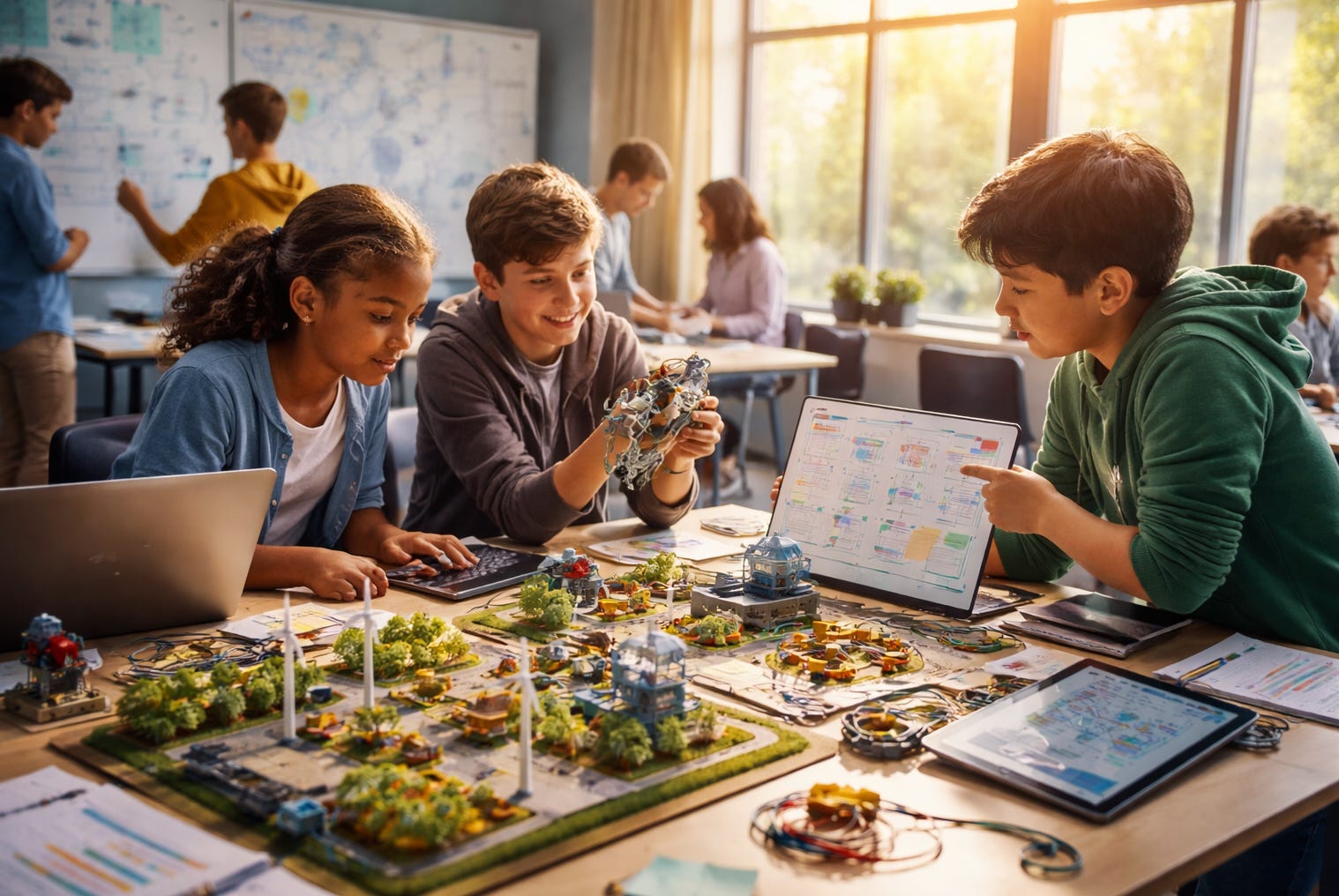
We can start with project-based learning that lets students tackle real-world issues and build their own systems from the ground up. Cross-disciplinary classes can show them how to blend math, technology, social sciences, and ethics into holistic solutions. AI-driven tools can act as coaches, giving real-time feedback so students learn to refine their designs instead of just using the technology as a crutch.
The focus needs to shift from teaching predefined solutions to teaching kids how to build the systems that can solve future problems. This will prepare them to work with AI—not just as users, but as designers and creators of the systems AI will optimize.
6. A Vision for the Future of Education
In the future, education will focus on systems thinking. Students will define problems and then build systems to solve them. Cross-disciplinary learning will integrate math, coding, design, social sciences, and ethics so kids learn to think holistically. AI will help them iterate on solutions, simulating real-world feedback and giving instant insights into how their systems work.
Programs like Edutopia and Frontiers in Education are already experimenting with systems thinking in the classroom. One study on System Dynamics simulations found that students who modeled local issues like traffic systems or ecosystems didn’t just memorize facts—they learned to spot feedback loops and iterate on their solutions in real time (Fisher, 2023).
Conclusion: A New Era of Learning
AI is changing the way we work and learn. Machines can execute, but humans must imagine. The future of education isn’t about memorizing answers or solving predefined problems—it’s about teaching kids to build systems that solve the problems we haven’t even named yet.
We’re standing at the edge of a new era. The kids who learn to think in systems won’t just keep up with AI—they’ll be the ones steering it.